How NUT's Default Polyunsaturated Fat Reference Values Were Derived

SourceForge.net Logo

How NUT's Default Polyunsaturated Fat Reference Values Were Derived

The essential polyunsaturated fats are substances our bodies cannot make and participate in so many important bodily functions that they deserve a place on a nutrition program's main screen alongside the essential vitamins and minerals.
The problem is that there is no consensus just how much of each of these fatty acids is required for a good diet, much less an optimum diet.

There is no Daily Value for the essential fats. The program "NUT" allows you to experiment and set the values as you wish. Nevertheless, it was necessary for me to come up with some reference values that would be the program defaults, and that would represent a significant amount of each of the fatty acids, and would be analogous to the Daily Value.

I had three basic choices:

  1. Follow the most common recommendations of the most vocal of the Omega-3 proponents, which include more Omega-3 than most people consume and severely limit Omega-6, usually in the context of a low-fat diet.
  2. Follow a laissez-faire approach and just use whatever average values appear when analyzing common varied diets.
  3. Follow a laissez-faire approach but make sure there is more Omega-3.

My personal experimentation over several years showed that choice 1 above was barely satisfactory for a low fat diet, led to an Omega-6 deficiency on a low carb diet, and was never optimal for hair and skin. Furthermore, setting the program's defaults to a regime that severely limited Omega-6 made many nutritious foods seem unacceptable. But because additional Omega-3 was so beneficial, choice 3 above was the only option that worked.

On the internet you will see discussions of the ratio between Omega-6 and Omega-3. They did "research." The correct ratio was determined to be "2:1". The author informs you he has cut out all "bad fats" and now eats only "good fats" (meaning Omega-3 and monounsaturated fat). The author is reducing the "inflammatory" arachidonic acid by eating less red meat and eating more poultry--in spite of the fact that poultry has much more arachidonic acid than red meat. It does not take much "research" to see that a lot of these ideas are bogus. When you try to plan diets to these bizarre specifications, you will find that only very limited low fat diets allow this degree of control over individual fatty acids. A much better strategy is to first provide ample amounts of all the essential fatty acids and then see later if an optimum can be determined. The short-chain plant versions of the essential fatty acids, Linoleic Acid (LA) and Alpha-Linolenic Acid (ALA), make their most visible effects in the hair and skin. The long-chain animal versions of the essential fatty acids, Arachidonic Acid (AA), Eicosapentaenoic Acid (EPA), and Docosahexaenoic Acid (DHA) have both subtle and profound effects throughout all bodily systems. Theoretically the long-chain fatty acids can be endogenously derived from the plant versions, but I would recommend against assuming that this is the case. And beware of presentations of the essential fatty acids as "medicine" for illness or as optional adjuncts for the health nut, as both tend to suggest too much Omega-3 or pointless Omega-6 supplementation. These are essential nutrients whose importance has been overlooked for years and one has to find their correct and necessary levels that promote normal functioning.

Whether you eat only the most nutritious whole foods or you eat mostly junk food, Linoleic Acid (Omega-6) is everywhere, and often accompanies the best sources of Vitamin E. Perhaps limiting LA when Omega-3 sources are poor is a good strategy, as this may lower your Omega-3 requirement--but I felt horribly deprived when I ate this way and did not think I looked well. It is easy to theorize that humans would do better with only 2% of calories from LA, but when it is time to actually plan meals that work, many of the most nutritious foods become impossible to fit in, and the resulting low-fat and high-carb diet is near the nadir of sub-optimal. Generally, I get around 6% of calories from LA.

Gamma-Linolenic Acid (Omega-6) is not found in any substantial amount in food sources, so I have taken the position that if I get the rest of my nutrition correct, GLA will take care of itself, being produced by the desaturation of LA. I prefer to try to find the natural balance of these fatty acids if it is at all possible and I am not persuaded of the need to supplement any Omega-6 fatty acid. Any insulin resistance from too much carbohydrate will inhibit the first desaturation step that leads to the fatty acids elaborated from LA and ALA. The enzyme that does this initial desaturation, called delta-6-desaturase, is the vital link that turns LA into GLA so that it can be elongated to Dihomo Gamma-Linolenic Acid (Omega-6). But since insulin resistance actually promotes the activity of the next enzyme down the line, delta-5-desaturase, GLA supplementation is futile because the GLA will just be turned into Arachidonic Acid instead, which you probably don't want.

Arachidonic Acid (Omega-6) is high especially in grain-fed poultry and eggs, and I get around 0.2% of calories from AA. Limiting this fatty acid to reduce inflammation is a rather ineffectual method compared with determining the actual cause of inflammation, such as too much carbohydrate, and remedying it. Also, studies show that dietary levels of AA affect the levels of anandamide and other endocannabinoids in the brain, and whatever this might mean in terms of brain function, I never found that AA restriction resulted in mood improvement. Indeed, I found that a moderate amount of AA from food intensifies the pleasurable effects from EPA and DHA.

Alpha-Linolenic Acid (Omega-3) is the most puzzling essential fatty acid and therefore creates the most diametrically-opposed opinions. ALA was the first essential fatty acid I "discovered" as I was learning about nutrition, and I substantially raised my intake of ALA for a period of time before beginning experiments with EPA and DHA from fish. I was struck by the positive mental changes that occurred when raising my intake of these latter fatty acids. So if ALA gets desaturated and elongated to EPA and DHA, why did I notice such a big difference adding EPA and DHA to my diet? I have to conclude that the amount of EPA and DHA created in the body from ALA is quite small. And the positive effects from ALA can be quite subtle and hard to figure out. I often found higher levels of ALA counterproductive--causing skin problems, inflammation, poorer mood, bleeding from just a scratch, and interfering with the action of chromium. There is an additional complication in that there is hardly any other way to significantly raise one's level of ALA without markedly increasing LA except flax. Dumping flax oil into your body can suddenly lower your blood sugar uncomfortably, and ground flax seed, although offering a slower and smoother way to absorb the oil, has such a high level of phytoestrogens in the fiber that men may feel the depressing anti-testosterone effect, and I am not sure the cyanide component helps your mood either. I came to the conclusion that the seeds are mildly toxic, and also that supplementation of ALA tends to be pro-inflammatory with very few obvious beneficial effects, so that I do not supplement ALA even if the amount in my food seems minimal.

The amazing mood and cognitive improvements and better hair and skin are only the most obvious benefits of Eicosapentaenoic Acid (Omega-3) and Docosahexaenoic Acid (Omega-3). It is quite certain that well-nourished humans have always eaten a lot of seafood, for there is no other way to obtain a proper level of both of these nutrients. For me, too little of these fatty acids first shows up as dandruff and dry scalp. I eat enough oily fish so that NUT shows an "Omega-6/3 Balance" of 75/25. I found that eating too much carbohydrate caused many side-effects from significant amounts of Omega-3 including some unpleasant vascular feelings in my head that were not quite a headache, or an otherwise indescribable "drugged-out" feeling, or anxiety, or a soreness around the coccyx, or an odd "dry" feeling throughout my body which could be reversed by a substantial amount of oily food containing Linoleic Acid. When carbs were optimal, the symptoms of too much Omega-3 were anxiety; soreness of the left heel; sore, rough skin on the left elbow; and an excessive amount of itchiness on the forehead.

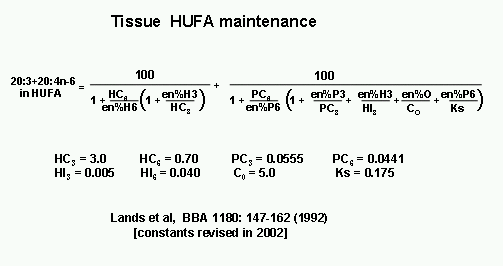
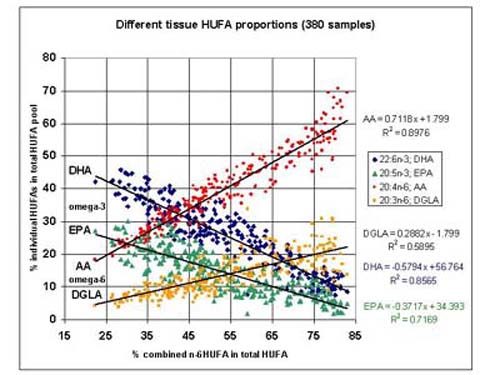
The newest version of NUT incorporates an empirical equation from Dr. William Lands that relates polyunsaturated fatty acid consumption to resulting percentages of Omega-6 highly unsaturated fatty acids in cell membrane phospholipids over the long term. The NUT reference values are refigured every time you do a reset from the analysis screen and they take into consideration all the fatty acids in the diet. NUT's modus operandi is to accept the user's levels of dietary Omega-6 fatty acids as 100% and find a balancing level of Omega-3 as directed by Lands' equation. You can raise the EPA and DHA percentages in the analysis either by increasing Omega-3 or reducing Omega-6 in your diet. If you would like to change NUT's target for the "Omega-6/3 Balance" value, you can do so in "Set Personal Options", "Essential Fatty Acid Options." Lands' group recommends an "Omega-6/3 Balance" value of 55/45, but in over a decade of careful experimentation, I have repeatedly found that value to result in 3 to 4 times the Omega-3 optimum. You can also change the maximum amount of EPA+DHA allowed. If the allowed EPA+DHA amount is below the amount necessary to reach the target, NUT will then show by how much Omega-6 must be lowered. If you would like to set your own reference values to exactly how you are eating, do an "e" reset on a characteristic period and then go to "Set Personal Options", "Essential Fatty Acid Options". Take "Accept current reference values as absolute amounts", and then when you come back to the analysis screen, reset with "m", "n", or "o".
Certainly, all who seriously want to understand these fatty acids would experiment and might find that NUT's program defaults are not satisfactory for their personal needs. Though I wish I could say they were easy, the polyunsaturated fatty acids are among the most difficult nutrients for which to figure out one's personal requirements, especially because it can take weeks or months to change the body's fat composition. I try to keep in mind that even though I do not know the last word for some of these nutrients, I know a lot more about them than if I had not experimented at all.

Home